Category: Blog

  • Successful Building-Wide HVAC Strainer Replacement at a District Cooling Residential Building in Dubai Marina

    MOLTEN Technical Services Successfully Completes a Comprehensive Strainer Replacement Project

    At MOLTEN Technical Services LLC, we are pleased to announce the successful completion of a comprehensive HVAC strainer replacement project at a district cooling-connected residential building in Dubai Marina, Dubai, UAE.

    The project involved replacing strainers throughout the building’s HVAC chilled water distribution system, demonstrating our technical team’s expertise in mechanical maintenance, chilled water piping systems, and district cooling-connected building infrastructure.

    Dubai Marina is home to numerous high-rise residential developments that rely on centralized cooling infrastructure to maintain comfortable indoor environments throughout the year.

    In buildings connected to district cooling networks, maintaining the internal chilled water distribution system is essential for reliable cooling performance.

    Our recently completed project demonstrates MOLTEN’s capability to execute building-wide mechanical maintenance activities within such environments.

    Understanding Strainers in District Cooling Systems

    District cooling systems supply chilled water from centralized cooling plants to connected buildings.

    Within each building, the chilled water distribution network transfers cooling energy to equipment such as Air Handling Units (AHUs) and Fan Coil Units (FCUs).

    Strainers are important components of these systems because they help prevent debris, sediment, rust particles, and other contaminants from reaching sensitive mechanical equipment.

    Over time, strainers may become blocked, damaged, or deteriorated, potentially affecting chilled water circulation.

    Poor strainer condition can contribute to:

    • Reduced chilled water flow
    • Increased pressure drop
    • Inconsistent cooling performance
    • Restricted water circulation
    • Additional stress on connected mechanical equipment
    • Increased maintenance requirements

    Regular inspection and timely replacement of damaged or deteriorated strainers help maintain the reliability of HVAC chilled water systems.

    Project Overview: Residential Building in Dubai Marina

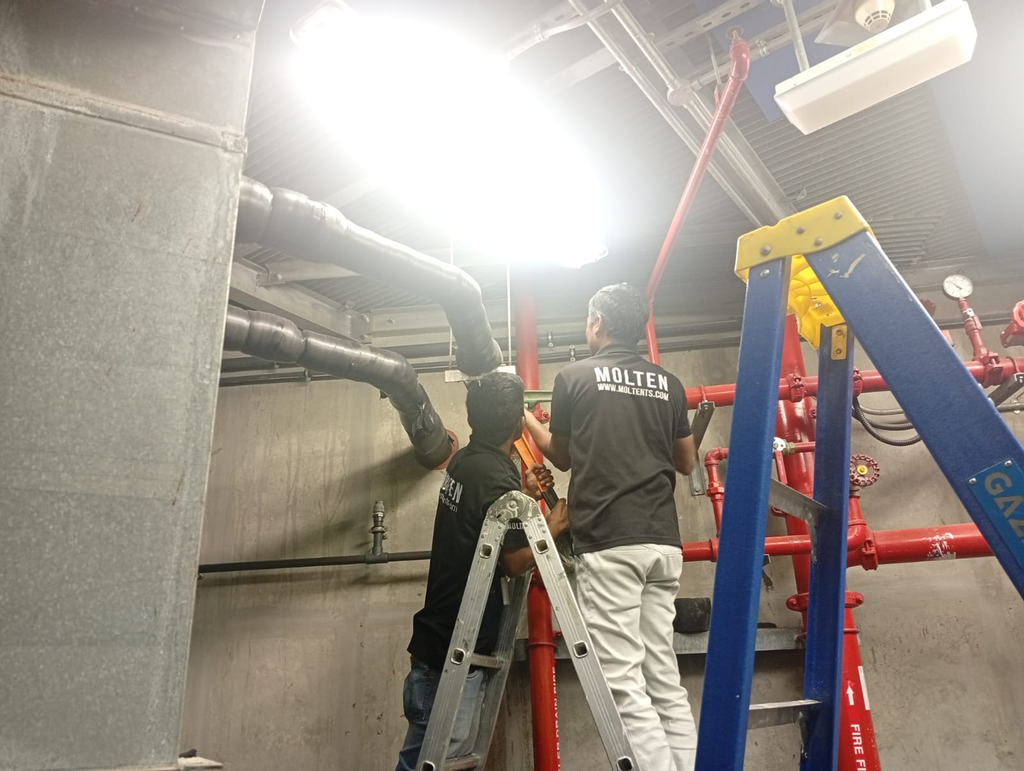
    Our technical team recently completed a comprehensive strainer replacement project at a residential building connected to a district cooling system in Dubai Marina.

    Project Details

    Location: Dubai Marina, Dubai, UAE

    Building Type: Residential Building

    Cooling System: District Cooling

    Service: HVAC Chilled Water Strainer Replacement

    Scope: Complete Building-Wide Strainer Replacement

    Contractor: MOLTEN Technical Services LLC

    Project Status: Successfully Completed

    The project required coordinated maintenance activities across the building’s chilled water piping network.

    Executing a building-wide replacement program requires careful planning, technical knowledge, appropriate isolation procedures, and effective coordination with building management.

    Our team successfully completed the assigned replacement scope, demonstrating our ability to undertake comprehensive HVAC mechanical maintenance projects.

    Technical Considerations in District Cooling Strainer Replacement

    Replacing strainers in district cooling-connected buildings requires an understanding of the chilled water distribution network and the operating requirements of connected equipment.

    Important technical considerations include assessing existing installations, selecting suitable replacement components, isolating the relevant piping sections, and restoring the affected systems safely.

    In occupied residential buildings, coordination with facility management is particularly important to minimize disruption to residents.

    Correct strainer installation also requires attention to flow direction, connection integrity, accessibility, and maintenance requirements.

    Following replacement, appropriate inspection and operational checks help verify that the affected piping sections are ready for service.

    At MOLTEN, our experience in HVAC testing, commissioning, chilled water balancing, and mechanical maintenance supports our ability to approach these projects with a comprehensive understanding of HVAC system performance.

    Why Strainer Maintenance Is Important for Dubai Marina Residential Buildings

    Residential buildings in Dubai Marina operate in demanding cooling conditions, particularly during the summer months.

    For buildings connected to district cooling networks, the performance of internal chilled water distribution systems directly influences cooling delivery to individual apartments and common areas.

    Maintaining strainers in good working condition helps protect connected equipment and supports reliable chilled water circulation.

    A coordinated building-wide maintenance program can also help facility management teams address multiple maintenance requirements efficiently.

    Depending on the condition of the existing components, strainer cleaning, repair, or replacement may be recommended.

    MOLTEN – Your Partner for District Cooling and HVAC Maintenance in Dubai

    MOLTEN Technical Services LLC provides specialized HVAC and mechanical maintenance services for residential towers, commercial buildings, hotels, shopping malls, and industrial facilities across the UAE.

    Our services include:

    • District Cooling Building-Side Maintenance
    • HVAC Strainer Replacement
    • Chilled Water Piping Maintenance
    • Chilled Water Flow Measurement
    • HVAC Water Balancing
    • Chilled Water System Troubleshooting
    • Pump and Valve Maintenance
    • HVAC Testing and Commissioning
    • HVAC Preventive Maintenance
    • HVAC System Performance Evaluation

    Our experienced technical team focuses on professional execution, system reliability, and long-term customer satisfaction.

    Looking for District Cooling Strainer Replacement Services in Dubai?

    If you are managing a residential tower, commercial property, or district cooling-connected building in Dubai Marina, Jumeirah Lake Towers (JLT), Business Bay, Downtown Dubai, or elsewhere in the UAE, MOLTEN can assist with your HVAC mechanical maintenance requirements.

    Whether you require individual strainer replacement, chilled water piping maintenance, or a complete building-wide maintenance project, our team is available to discuss your requirements.

    Contact MOLTEN Technical Services LLC

    Creating Healthy Environments

    📍 Al Quoz Industrial Area 03, Dubai, UAE

    📞 +971 4 338 3155 | +971 503914723 | +971 566855891

    📧 info@moltents.com | www.moltents.com

  • Fabric Duct Systems in Dubai, UAE –

    Modern, Efficient & Sustainable Air Distribution Solutions

    Fabric Duct Suppliers & Installation Services in Dubai | MOLTEN Technical Services LLC

    As modern buildings demand better indoor air quality, energy efficiency, and improved air distribution, Fabric Duct Systems are becoming an increasingly attractive alternative to conventional metal ductwork.

    At MOLTEN Technical Services LLC, Dubai, we provide fabric air distribution solutions for commercial, industrial, and specialized HVAC applications. Our services cover fabric duct supply, technical selection, installation, testing, and commissioning to help clients achieve efficient and comfortable indoor environments.

    Whether you are developing a new industrial facility, warehouse, sports complex, commercial building, or food processing facility, fabric air ducts offer a flexible and visually appealing approach to air distribution.

    What Is a Fabric Duct System?

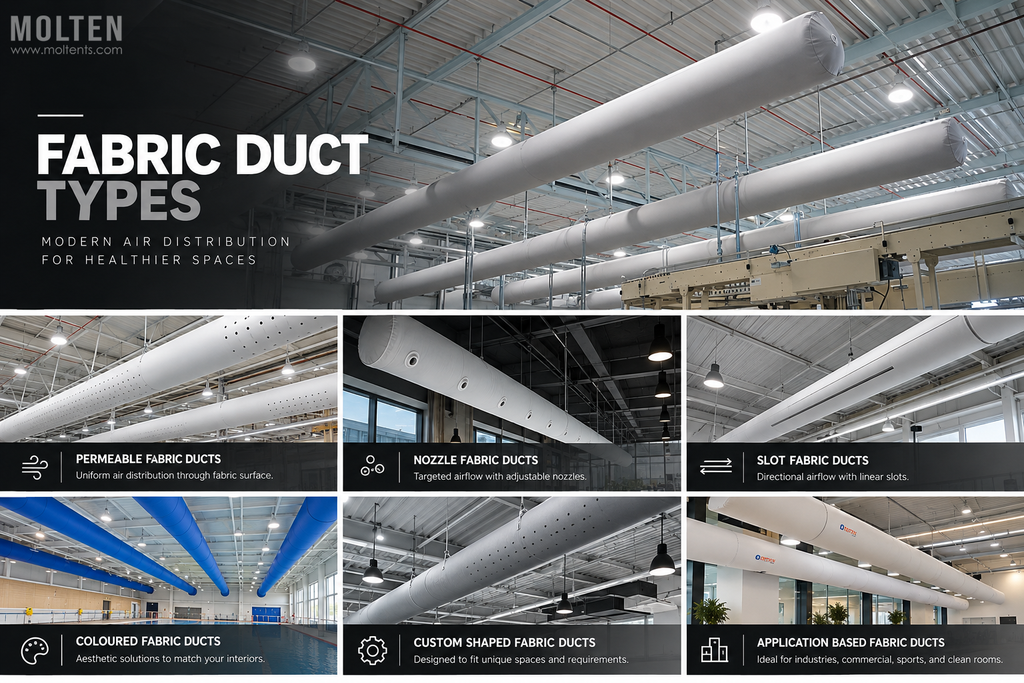
    A Fabric Duct System, also known as a Textile Air Duct, Fabric Air Duct, or Fabric Air Dispersion System, is an HVAC air distribution solution manufactured using specially engineered textile materials.

    Unlike traditional galvanized steel or aluminum ductwork, fabric ducts distribute conditioned air through engineered fabric surfaces, perforations, nozzles, or linear openings.

    These systems are generally lightweight, customizable, and suitable for applications requiring controlled airflow distribution.

    Fabric duct systems can be designed to deliver conditioned air across large spaces while minimizing uncomfortable drafts and supporting consistent indoor temperatures.

    Types of Fabric Duct Systems

    Different fabric duct configurations are available depending on the airflow requirements, building design, and application.

    1. Permeable Fabric Ducts

    Permeable fabric ducts distribute air through the textile surface.

    They are particularly suitable for applications requiring gentle air dispersion and reduced drafts.

    Typical applications:

    • Food processing facilities
    • Commercial spaces
    • Laboratories
    • Temperature-sensitive environments

    2. Perforated Fabric Ducts

    Perforated fabric ducts feature precisely engineered openings that control airflow direction and distribution.

    The size, spacing, and arrangement of perforations can be selected based on project requirements.

    Typical applications:

    • Warehouses
    • Industrial facilities
    • Manufacturing plants
    • Sports halls
    • Large commercial spaces

    3. Nozzle Fabric Ducts

    Nozzle fabric ducts incorporate specially designed outlets that direct air toward specific areas.

    These systems are suitable where targeted airflow or longer air throw distances are required.

    Typical applications:

    • High-ceiling warehouses
    • Industrial production facilities
    • Large assembly areas
    • Manufacturing plants

    4. Slot Fabric Ducts

    Slot fabric ducts use engineered linear openings to distribute air in specific directions.

    These systems can be designed to meet particular airflow patterns and architectural requirements.

    Typical applications:

    • Commercial interiors
    • Exhibition halls
    • Retail facilities
    • Large open spaces

    5. Custom-Shaped Fabric Ducts

    Fabric ducts are available in different configurations, including:

    • Circular fabric ducts
    • Half-round fabric ducts
    • Quarter-round fabric ducts
    • Rectangular fabric ducts
    • Custom-designed profiles

    The selection depends on ceiling height, available installation space, airflow requirements, and architectural considerations.

    Benefits of Fabric Duct Systems

    Uniform Air Distribution

    Fabric ducts can be engineered to distribute conditioned air evenly throughout the occupied space, improving thermal comfort.

    Lightweight Construction

    Compared with conventional metal ductwork, fabric ducts are lightweight and can simplify handling and installation.

    Improved Indoor Comfort

    Properly designed fabric air distribution systems can reduce uncomfortable drafts and help maintain consistent indoor temperatures.

    Flexible Design Options

    Fabric ducts are available in various shapes, sizes, colors, and configurations to complement modern architectural designs.

    Easy Maintenance

    Many fabric duct systems feature removable textile sections that can be cleaned according to manufacturer recommendations.

    Energy-Efficient Air Distribution

    When correctly designed, fabric duct systems can support efficient air distribution and HVAC performance.

    Actual energy savings depend on the overall HVAC system design, operating conditions, and application.

    Fabric Duct Applications in Dubai and UAE

    Fabric air distribution systems are suitable for a wide range of commercial and industrial environments.

    Industrial Facilities and Warehouses

    Fabric ducts provide customizable air distribution solutions for large industrial spaces, manufacturing facilities, and warehouses.

    Food Processing Facilities

    Selected fabric duct materials and configurations can support hygienic air distribution requirements in food production environments.

    Sports Halls and Gymnasiums

    Fabric duct systems can distribute conditioned air across large indoor sports facilities while maintaining occupant comfort.

    Commercial Buildings and Retail Spaces

    Fabric ducts offer an aesthetically appealing air distribution solution for commercial interiors and open-ceiling architectural designs.

    Exhibition Halls and Event Facilities

    Lightweight fabric duct systems can be designed for large spaces requiring flexible air distribution arrangements.

    Laboratories and Specialized Facilities

    Application-specific fabric duct systems may be considered where controlled airflow distribution is required, subject to applicable technical and hygiene standards.

    Fabric Duct Design and Installation in Dubai

    At MOLTEN, we understand that effective air distribution requires more than selecting the right duct material.

    Our engineering approach considers the complete HVAC system and its operating requirements.

    Our Fabric Duct Services Include:

    1. Technical Consultation

    Understanding project requirements, building applications, and HVAC performance expectations.

    2. Fabric Duct Selection

    Selecting appropriate fabric materials, duct configurations, and airflow distribution methods.

    3. Airflow Design Coordination

    Reviewing airflow quantities, duct dimensions, air velocity, and distribution requirements.

    4. Fabric Duct Supply

    Providing fabric air distribution systems according to approved technical specifications and project requirements.

    5. Professional Installation

    Installation of fabric ducts, suspension arrangements, and associated components.

    6. Testing and Commissioning

    Verifying airflow performance and coordinating adjustments to achieve the intended air distribution.

    Our experience in HVAC testing, commissioning, and air balancing supports a technically focused approach to fabric duct installations.

    Why Choose MOLTEN for Fabric Duct Systems in UAE?

    MOLTEN Technical Services LLC is a Dubai-based HVAC engineering company established in 2018.

    We specialize in HVAC testing and commissioning, air balancing, water balancing, HVAC design, installation, maintenance, and technical services.

    Our experience across commercial and industrial HVAC systems enables us to understand the importance of proper airflow distribution, system performance, and indoor environmental quality.

    With our focus on engineering precision, quality workmanship, and customer satisfaction, we aim to provide reliable fabric duct solutions tailored to individual project requirements.

    Our Commitment: Creating Healthy Environments.

    Looking for Fabric Duct Suppliers or Installation Services in Dubai?

    If you are planning a new HVAC installation, upgrading an existing air distribution system, or exploring fabric duct solutions for your facility, MOLTEN can assist with technical consultation, product selection, supply, and installation.

    We support fabric duct requirements for commercial, industrial, and specialized applications across Dubai and the UAE.

    Contact MOLTEN Technical Services LLC

    📍 Al Quoz Industrial Area 03, Dubai, UAE
    📞 +971 4 338 3155 | +971529716792 | +971 503914260

    ✉️ info@moltents.com | 🌐 www.moltents.com

    MOLTEN – Creating Healthy Environments

  • BIM Modeling Services in Dubai, UAE

    Smarter Models. Better Coordination. Better Project Delivery.

    At MOLTEN Technical Services LLC, we provide professional BIM Modeling and Coordination services to support smarter, more accurate and efficient project delivery.

    By combining digital engineering with our practical HVAC and MEP expertise, we help consultants, contractors and developers identify coordination issues early, minimize site conflicts and move from design to construction with greater confidence.

    Our BIM Services

    Our capabilities include Architectural BIM Modeling, Structural BIM Modeling, MEP BIM Modeling, BIM Coordination & Clash Detection, Scan-to-BIM, CAD/PDF-to-BIM, coordinated drawings and BIM resource support.

    We support BIM development across different project requirements, including LOD 350, LOD 400 and LOD 500 models.

    From Digital Models to Real-World Performance

    For HVAC and MEP projects, good coordination is critical. Ductwork, chilled-water piping, plumbing, fire-fighting systems, electrical services and structural elements must all work together within limited building spaces.

    BIM allows these systems to be coordinated digitally before installation, helping reduce clashes, unnecessary modifications, delays and rework on site.

    At MOLTEN, we combine BIM with our experience in HVAC design, Testing & Commissioning, Air Balancing, Water Balancing and building performance, creating a stronger connection between the digital model and the actual building.

    Selected BIM Project Experience

    Our BIM project portfolio includes:

    Seven City JLT – Dubai, UAE
    LOD 400 MEP BIM modeling, coordination and sheet creation.

    Peninsula – Dubai, UAE
    BIM clash coordination and sheet creation with coordinated LOD 400 MEP models.

    Data Centre – Dubai, UAE
    LOD 350 BIM modeling and sheet development for MEPF services.

    Mall Project – Dubai, UAE
    BIM coordination for fire-fighting services with LOD 350 modeling.

    Singapore Metro Station – Singapore
    LOD 350 modeling and clash coordination for Architectural, Structural and MEP systems.

    Airport Scan-to-CAD – Riyadh, Dammam & Jeddah, Saudi Arabia
    Development of 500+ MEP CAD drawings from scanned information for airport maintenance and terminal updates.

    Hospital Project – Malaysia
    LOD 400 coordinated MEP BIM modeling and project documentation.

    BIM Modeling with MOLTEN

    From BIM Modeling and Clash Detection to Scan-to-BIM and MEP coordination, our focus is on delivering accurate digital information that supports better construction decisions and better-performing buildings.

    Smarter Models. Stronger Buildings.

    MOLTEN Technical Services LLC
    Creating Healthy Environments

    📞 +971 4 338 3155 | +971 529716792
    📧 info@moltents.com
    🌐 www.moltents.com

  • HVAC Equipment Supply in Dubai – FCUs, DX Units & Trusted Brands

    Choosing the right HVAC equipment is an important part of achieving reliable cooling, energy efficiency, and long-term system performance. At MOLTEN Technical Services LLC, we support our clients not only with HVAC engineering and technical services, but also with the supply of HVAC equipment for commercial, residential, and industrial applications across Dubai and the UAE.

    Fan Coil Units (FCUs)

    Fan Coil Units are widely used in chilled-water air-conditioning systems across offices, hotels, apartments, commercial buildings, and other facilities.

    We supply FCUs from leading HVAC brands, including Carrier, Daikin, LG, and other established manufacturers, depending on project requirements and availability.

    Selecting the right FCU requires more than simply matching the cooling capacity. Airflow, external static pressure, chilled-water conditions, noise level, installation space, controls, and maintenance accessibility should all be considered to achieve the required performance.

    DX Air-Conditioning Units

    MOLTEN also supplies DX (Direct Expansion) air-conditioning units for a variety of applications.

    DX systems provide direct cooling through the refrigeration cycle and can be an effective solution for many residential, commercial, office, retail, and technical applications.

    We can support customers in identifying suitable equipment based on cooling requirements, application, available space, system configuration, and project specifications.

    HVAC Equipment from Trusted Brands

    Depending on project requirements, we can support the supply of HVAC equipment from well-known brands such as Carrier, Daikin, LG, and other major HVAC manufacturers.

    Our engineering background helps us look beyond equipment supply. The objective is to help clients select equipment that suits the actual system requirements and can deliver reliable performance after installation.

    From Equipment Selection to System Performance

    An HVAC unit can perform effectively only when it is properly selected, installed, commissioned, and maintained.

    MOLTEN provides a wider range of HVAC engineering services, including HVAC design and consultancy, equipment selection, installation support, testing and commissioning, air balancing, water balancing, maintenance, servicing, and system performance optimization.

    This allows us to support clients throughout different stages of their HVAC requirements — from selecting equipment to achieving the required indoor conditions.

    Looking for FCUs or DX Units in Dubai?

    If you are looking for Fan Coil Units (FCUs), DX units, or other HVAC equipment in Dubai or across the UAE, contact MOLTEN Technical Services LLC with your equipment schedule, specifications, model requirements, or project details.

    Our team can review your requirements and assist with a suitable HVAC solution.

    MOLTEN Technical Services LLC
    Creating Healthy Environments

    Website: www.moltents.com
    Email: info@moltents.com
    Phone: +971 529716792
    Location: Al Quoz Industrial Area 03, Dubai, UAE

  • Benefits of Thermography for Testing and Commissioning

    Benefits of Thermography for Testing and Commissioning

    Thermography in Testing and Commissioning

    In today’s complex electrical and mechanical environments, precision during testing and commissioning is critical. Whether it’s a new installation or a system upgrade, ensuring every component performs safely and efficiently before handover can prevent costly failures later. One of the most reliable and non-invasive tools used in this phase is thermography.

    At MOLTEN, thermographic testing plays a vital role in delivering dependable, high-performance systems across commercial and industrial projects.

    What is Thermography?

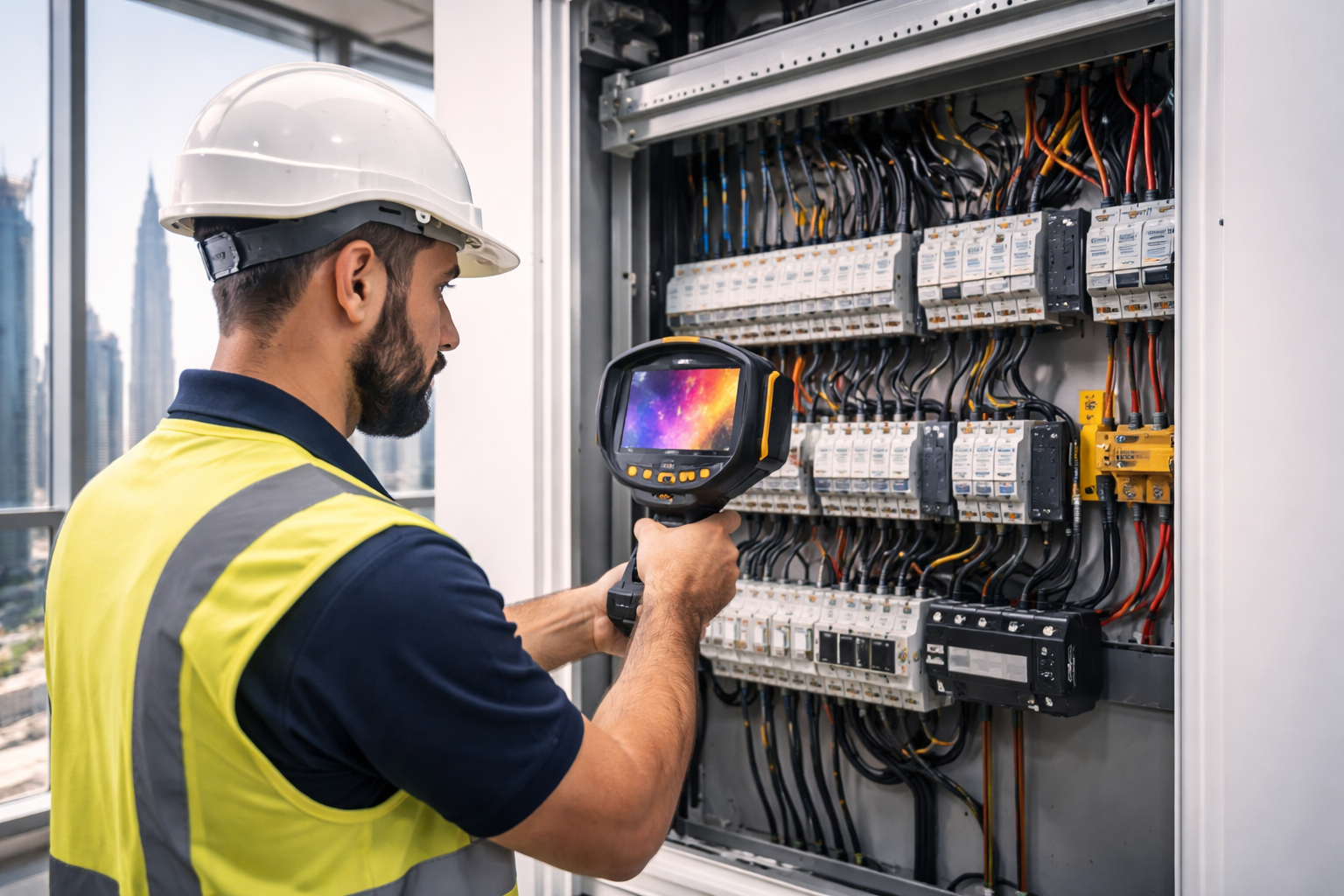
    Thermography is the process of using infrared cameras to detect temperature variations on the surface of equipment and systems. Since excessive heat is often the first sign of an underlying issue, thermal imaging allows engineers to identify faults that are invisible to the naked eye—without shutting down operations.

    1. Early Detection of Electrical Faults

    During testing and commissioning, thermography helps detect loose connections, overloaded circuits, phase imbalances, and faulty components in electrical panels, switchgear, transformers, and cable terminations.

    Heat anomalies typically indicate resistance or stress within the system. Identifying these issues before full-scale operation ensures reliability and significantly reduces the risk of breakdowns, short circuits, or fire hazards.

    2. Non-Invasive and Safe Inspection

    One of the biggest advantages of thermography is that it is completely non-contact. Equipment can be inspected while energized and under load, which provides real-time performance data without interrupting operations.

    This approach enhances safety for technicians and avoids the downtime that traditional inspection methods may require.

    3. Improved System Reliability

    Commissioning is not just about verifying that systems are installed—it’s about confirming they perform optimally under actual working conditions. Thermal imaging validates the integrity of electrical connections and load distribution, ensuring the system is stable and balanced before project handover.

    By addressing thermal irregularities early, organizations can avoid premature equipment failure and ensure long-term operational reliability.

    4. Cost Savings Through Preventive Action

    Unidentified heat buildup can lead to insulation damage, equipment degradation, and unexpected shutdowns. Thermographic testing allows teams to correct minor issues before they escalate into expensive repairs or replacements.

    Investing in thermal inspections during commissioning reduces future maintenance costs and protects critical assets.

    5. Comprehensive Documentation and Reporting

    Thermographic scans generate detailed visual reports with temperature readings and thermal patterns. These reports become part of the commissioning documentation, providing clients with clear evidence that systems were thoroughly tested and verified.

    This documentation is particularly valuable for compliance, audits, insurance requirements, and long-term maintenance planning.

    6. Faster Commissioning Process

    Because thermography allows quick scanning of large areas and multiple components, it accelerates the inspection process. Engineers can efficiently assess panels, busbars, terminations, and mechanical systems without dismantling equipment.

    This streamlined approach helps projects stay on schedule while maintaining high quality standards.


    Why Choose MOLTEN for Thermographic Testing?

    At MOLTEN, thermographic inspections are conducted by trained professionals using advanced infrared technology. Every inspection is backed by systematic analysis and clear reporting, ensuring clients receive accurate diagnostics and actionable insights.

    By integrating thermography into testing and commissioning, MOLTEN ensures safety, efficiency, and long-term performance—right from day one.

    Thermal imaging is not just an inspection method; it is a proactive strategy for delivering reliable, future-ready systems.

  • HVAC Commissioning: Non-Negotiable for Every High-Performance Building

    HVAC Commissioning: Non-Negotiable for Every High-Performance Building

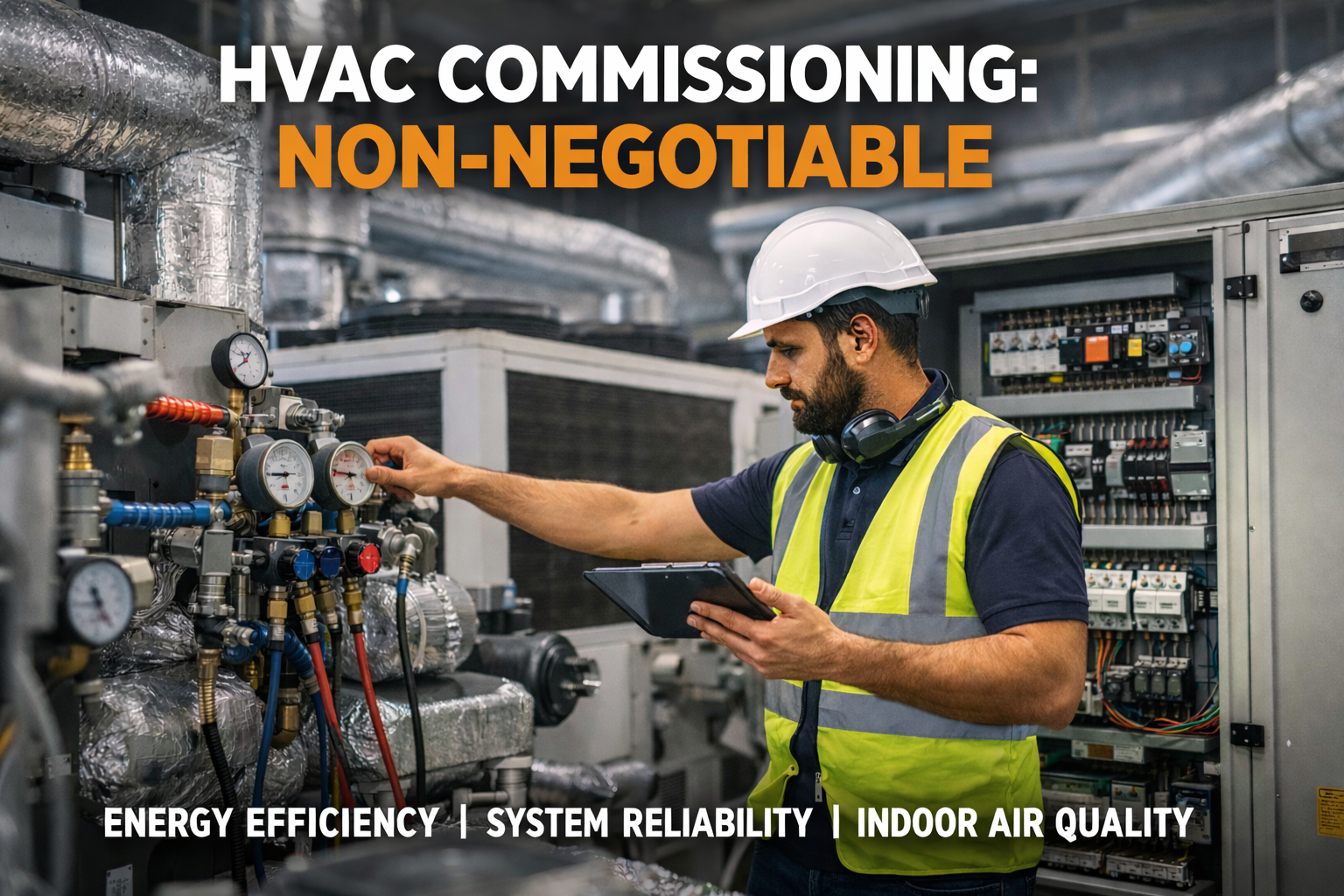
    In today’s fast-evolving built environment, installing an HVAC system is only half the job. The real performance of a building begins when the system is tested, verified, and optimized. This is where HVAC commissioning becomes non-negotiable. Without proper HVAC commissioning, even the most advanced systems can underperform, waste energy, and compromise occupant comfort.

    HVAC commissioning is a structured process that ensures every component of the system—chillers, air handling units, ducting, controls, and sensors—operates exactly as designed. It validates that the HVAC system meets project requirements, energy targets, and indoor air quality standards. For commercial, industrial, and residential developments in the UAE, this process is critical due to the region’s extreme climate and high energy demands.

    One of the primary benefits of HVAC commissioning is system reliability. Uncommissioned systems often suffer from airflow imbalances, incorrect control sequences, and hidden installation errors. These issues may not be visible at handover but surface later as frequent breakdowns and costly repairs. Through professional HVAC testing and commissioning, potential failures are identified early, reducing downtime and extending equipment life.

    Another vital outcome is energy efficiency. Buildings in the UAE rely heavily on HVAC systems, making energy performance a top priority. Proper HVAC commissioning ensures that systems operate at optimal efficiency, preventing overcooling, short cycling, and unnecessary power consumption. Studies consistently show that commissioned buildings achieve up to 20–30% energy savings compared to non-commissioned ones. For developers and facility managers, this translates into lower operational costs and improved sustainability ratings.

    Indoor air quality is equally impacted. A poorly commissioned HVAC system can lead to uneven temperatures, stale air, and humidity issues—directly affecting occupant health and productivity. HVAC commissioning verifies airflow rates, filtration performance, and fresh air intake, ensuring a healthy and comfortable indoor environment.

    At MOLTEN, we view HVAC commissioning not as an optional add-on, but as a core responsibility. As one of the best HVAC companies in the UAE, our commissioning approach combines technical precision with real-world performance validation. Every project undergoes detailed inspection, functional testing, and performance tuning, aligned with international standards and local regulations.

    In a competitive construction landscape, skipping HVAC commissioning may seem like a cost-saving measure. In reality, it creates long-term risks—higher energy bills, frequent maintenance, and dissatisfied occupants. Commissioning protects the investment made in HVAC infrastructure and guarantees that the system delivers what it promises.

    The message is simple: Install smart. Test thoroughly. Trust only what’s proven.
    Because when it comes to building performance, HVAC commissioning isn’t optional—it’s non-negotiable.

  • Preparing Your HVAC System for Dubai’s winter: Essential Tips from MOLTEN

    Preparing Your HVAC System for Dubai’s winter: Essential Tips from MOLTEN

    As Dubai transitions from its scorching summer to the cooler winter months, it’s important to prepare your HVAC system for the change. While Dubai’s winters are mild compared to the harsh summer, nighttime temperatures can drop significantly, and your HVAC system plays a vital role in maintaining comfort. Proper preparation not only ensures energy efficiency but also extends the life of your unit, helping you avoid unexpected breakdowns during peak usage.
    In this guide, we’ll cover the key steps to get your HVAC system ready for the winter, so you can enjoy a comfortable, hassle-free season.

    Schedule a Professional HVAC Inspection

    One of the most effective ways to prepare your HVAC system for winter is to schedule a professional inspection. During Dubai’s summer, your air conditioning works overtime, potentially leading to wear and tear. A comprehensive inspection can identify any issues such as worn-out components, refrigerant or Water leaks, or electrical problems.
    At MOLTEN, we recommend annual maintenance before the winter season to ensure everything is functioning optimally. A well-maintained HVAC system not only keeps your home or business comfortable but also helps reduce energy bills by improving efficiency.

    Clean or Replace Air Filters

    Dust and sand accumulation are common problems in Dubai’s environment. Over time, HVAC filters become clogged, reducing airflow and making your system work harder than it should. This can lead to higher energy consumption and reduced indoor air quality. Before winter sets in, clean or replace your air filters to ensure your system runs efficiently.

    Why Clean Air Filters Matter:

    • Improved air circulation
    • Reduced strain on your HVAC system
    • Enhanced indoor air quality, especially important for homes with allergies or respiratory issues
    Check and Clean Ductwork

    Dubai’s dust-filled environment can affect your ductwork, leading to blockages and inefficiencies in air distribution. Ensuring your ducts are clean is an essential part of preparing your HVAC system for winter. Clogged ducts can reduce airflow, forcing your system to work harder to maintain a consistent temperature, which may result in higher energy bills.
    Regular duct cleaning can improve your HVAC system’s performance, reduce energy costs, and enhance indoor air quality. For commercial buildings, this step is even more critical due to the larger areas being heated or cooled.

    Test Your Thermostat

    As temperatures drop, you may want to switch from cooling to heating. Before winter begins, ensure that your thermostat is functioning correctly. If your thermostat is outdated or showing signs of malfunction, consider upgrading to a programmable or smart thermostat. These modern systems allow for better temperature control and can help you save on energy bills by automatically adjusting temperatures based on your schedule.

    Inspect and Clean HVAC Coils

    Both the evaporator and condenser coils in your HVAC system can collect dirt over time, especially after heavy summer use in Dubai. Dirty coils reduce the system’s efficiency, making it harder to maintain your desired temperature. Before winter, it’s important to clean the coils to improve heat exchange and maintain system efficiency.

    Seal Any Air Leaks

    Air leaks around windows, doors, and ductwork can cause heat loss during winter, forcing your HVAC system to work harder to maintain the indoor temperature. Sealing these leaks will improve your system’s efficiency, reduce energy consumption, and keep your space warm and comfortable.
    Use weather stripping and caulk around windows and doors, and ensure that ductwork is properly sealed.

    Set up a Preventive Maintenance Plan

    Regular maintenance is key to ensuring your HVAC system operates smoothly year-round. At MOLTEN, we offer preventive maintenance plans that are tailored to the unique challenges of Dubai’s climate. Our expert technicians can help you maintain your HVAC system, ensuring it runs efficiently during both the summer and winter seasons.
    Conclusion: Stay Ahead with Proper Winter HVAC Preparation

    While Dubai’s winters are mild, ensuring your HVAC system is ready for the cooler months is essential for maintaining comfort and energy efficiency. By scheduling a professional inspection, cleaning your air filters and ductwork, checking your thermostat, and sealing air leaks, you can prevent issues before they arise and ensure your HVAC system runs smoothly throughout the winter.

    At MOLTEN, we specialize in providing HVAC services designed for Dubai’s unique climate. Contact us today to schedule your winter HVAC maintenance and keep your system running efficiently year-round.

    Written By: Jithu K Joseph, MOLTEN

  • Understanding Commercial HVAC Systems

    Understanding Commercial HVAC Systems

    Commercial vs. Residential HVAC Systems: Key Differences and What to Consider in Dubai

    When it comes to heating, ventilation, and air conditioning (HVAC) systems, commercial and residential setups differ significantly in design, installation, and functionality. In Dubai’s unique climate, which demands high-performance cooling, understanding these differences is essential to selecting the right HVAC system for your needs. Whether you’re a business owner or a homeowner, this guide by MOLTEN explains the distinctions and factors to consider, helping you make an informed choice.

    Understanding Commercial HVAC Systems

    Commercial HVAC systems are specifically designed to serve larger spaces, such as office buildings, malls, hotels, and warehouses. These systems require greater capacity and flexibility to manage the demands of varied environments within one structure.

    • Designing & Testing and Commissioning: In commercial air conditioning systems, it is essential to perform accurate heat load calculations, prevent heat gain from external sources, and ensure thorough testing and commissioning. This includes air balancing, water balancing, and duct leak testing.
    • Size and Complexity: Commercial systems are generally much larger and more complex than residential systems to meet the needs of large spaces and multiple rooms. They are often modular, meaning they can be customized and expanded according to the building’s requirements.
    • Zoning and Flexibility: Commercial HVAC systems usually allow for zoning, meaning that temperature control can be customized in different areas of the building. For example, conference rooms, lobbies, and individual offices may require different temperature settings, which is achievable through advanced commercial HVAC setups.
    • Maintenance Needs: Due to their larger size and complexity, commercial HVAC systems require regular maintenance by certified technicians to prevent breakdowns and ensure optimal performance. With Dubai’s extreme temperatures, regular maintenance is essential to avoid disruptions and manage energy costs.
    Understanding Residential HVAC Systems

    Residential HVAC systems are designed for private homes and typically cater to smaller spaces. They are built with a focus on simplicity and ease of use, suitable for cooling and heating single-family homes, villas, or apartments.

    • System Type:
      Residential systems are often single-unit systems (like split systems or window units) and are designed to cool or heat one space or a small number of rooms. They don’t require the same level of zoning or flexibility as commercial systems, making them simpler and more affordable.
    • Efficiency and Noise Control:
      Residential units are generally quieter, as they are built to fit seamlessly into living environments without causing disturbances. Energy efficiency is also a key focus, as residential users often prioritize lower utility bills.
    • Maintenance Requirements:
      Residential systems are simpler to maintain than commercial setups, requiring basic cleaning and filter replacement. However, given Dubai’s dusty environment, it’s still essential for homeowners to schedule routine maintenance to ensure efficient cooling performance.

    Testing & Commissioning in residential projects, testing and commissioning are crucial, including air balancing, water balancing, and duct leak testing. Improper air balancing can lead to issues such as unpleasant odors, mold growth on walls due to humidity, infiltration of unconditioned air, and insufficient fresh air supply.

    Key Differences Between Commercial and Residential HVAC Systems
    • Size and Capacity:
      Commercial systems have a higher capacity to serve large spaces, while residential systems are compact and tailored for smaller areas.
    • Design and Installation Complexity:
      Commercial systems are modular and often require professional design and installation. Residential systems are more straightforward and require less specialized installation.
    • Zoning Options:
      Zoning is crucial in commercial spaces to ensure different areas receive customized temperatures, whereas residential systems typically cool or heat entire homes without specific zones.
    • Maintenance Frequency:
      Commercial HVAC systems require frequent professional maintenance due to their size and complexity, while residential systems need less intensive upkeep.
    • Energy Usage and Cost:
      Due to the size and scope of commercial HVAC systems, they consume more energy and thus come with higher operational costs. However, energy-efficient technology can significantly reduce these expenses over time.

    Testing & Commissioning Is crucial for any HVAC Systems, especially in residential projects improper testing and commissioning in HVAC Systems, Improper air balancing can lead to issues such as unpleasant odors, mold growth on walls due to humidity, infiltration of unconditioned air, and insufficient fresh air supply.

    Factors to Consider for HVAC Systems in Dubai

    Choosing the right HVAC system for Dubai’s unique climate is essential for comfort and energy efficiency. Here are some key considerations for both residential and commercial setups:

    For Commercial Spaces

    • System Capacity:
      Choose an HVAC system with sufficient capacity to handle large spaces and frequent usage, especially during Dubai’s summer months.
    • Energy Efficiency:
      Given high energy costs, consider energy-efficient systems with modern technologies, such as variable refrigerant flow (VRF) and smart thermostats, which allow for better control over energy usage.
    • Humidity Control:
      High humidity levels in Dubai can impact indoor air quality. Commercial systems with humidity control features help maintain a comfortable environment and reduce the risk of mold growth.

    For Residential Spaces

    • Size of the Space:
      Select a system based on the size of your home. Split AC units are ideal for single rooms, while centralized systems are best for larger homes with multiple rooms.
    • Quiet Operation:
      Homeowners typically prioritize quieter systems, especially for bedrooms and living areas. Many residential HVAC units offer noise reduction features to maintain comfort without disruption.
    • Maintenance Schedule:
      Routine maintenance, such as filter cleaning and coil inspection, is essential in Dubai’s dusty environment to keep the system functioning efficiently.
    Why Choose MOLTEN for Your HVAC Needs in Dubai?

    MOLTEN provides precise, site-specific measurements using our calibrated testing and commissioning instruments, along with skilled technicians and engineers. Many HVAC companies rely on MOLTEN’s expert advice and consultancy to solve the most complex HVAC challenges in Dubai,
    At MOLTEN, we specialize in providing tailored HVAC solutions for both residential and commercial clients across Dubai. We understand the unique climate challenges and have the expertise to recommend and install the best systems for optimal comfort and energy efficiency. Whether you’re looking for a compact unit for your home or a robust system for a commercial space, our team is here to guide you through every step.
    Contact us today to schedule a consultation and discover how MOLTEN can help you find the perfect HVAC system to match your specific needs in Dubai.

    By Pushparaj Poojari
    Projects Coordinator
    MOLTEN

  • How MOLTEN Solved the Biggest Project Management Challenges in Engineering Services

    How MOLTEN Solved the Biggest Project Management Challenges in Engineering Services

    In the fast-paced world of engineering services, managing projects isn’t just about tracking deadlines and deliverables. It’s a complex ecosystem involving multiple stakeholders—clients, site teams, subcontractors, suppliers, transportation partners, and government authorities. Every day brings a fresh set of coordination challenges, cost constraints, and technical hurdles. Without a solid project management framework, the entire process can quickly spiral out of control.

    At MOLTEN, we realized early on that traditional tools and spreadsheets weren’t enough to keep pace with the dynamic demands of our industry. We needed something smarter—something built around how we work. That’s when the idea of developing our own project management system was born.

    Over several years of experimentation, learning, and collaboration with subject matter experts, engineers, and technology consultants, we built a custom digital platform tailored specifically for engineering service operations. The goal was simple: make project management easier, more transparent, and more efficient—for everyone involved.

    What Makes Our System Unique?

    Unlike generic project tracking software, our system is engineered around real-world workflows that reflect what happens on the ground. It’s not just a task list or a Gantt chart—it’s an integrated environment where all stakeholders can connect, update, and collaborate in real time.

    Whether you’re a site supervisor at a remote location or a client abroad, our system brings you into the loop through a centralized platform accessible from anywhere in the world. From project planning and documentation to progress tracking and issue resolution, everything is managed in one unified space.

    Built by Us, for Us

    One of the proudest aspects of this system is that it wasn’t bought off the shelf—it was built in-house. Our team knew exactly where the gaps were and what kind of solutions were needed. Over time, we fine-tuned the platform to handle:

    • Real-time site updates
    • Centralized document control
    • Budget monitoring and cost control
    • Resource scheduling
    • Subcontractor coordination
    • Client communication
    • Quality and safety tracking

    It took hard work, patience, and multiple iterations, but today our system forms the backbone of MOLTEN’s operations. It empowers our teams to stay organized, act fast, and deliver consistent results without chaos or miscommunication.

    The Result: Clarity and Control

    Thanks to this platform, we’ve been able to improve project delivery timelines, reduce rework, and keep our clients more informed and satisfied. Internal coordination has never been smoother. More importantly, it allows us to scale our operations confidently, knowing we have a strong digital foundation backing every project.

    At MOLTEN, we believe that innovation doesn’t always mean fancy gadgets—it means finding smarter ways to solve old problems. Our project management system is a perfect example of that philosophy in action.

    Want to know more about how we deliver projects with precision and reliability?

    Get in touch with our team or explore our project capabilities today.

    #EngineeringInnovation #ProjectSuccess #TeamMOLTEN #ConstructionManagement #BuiltByMOLTEN

  • 5 Signs It Is Time to Replace HVAC System

    5 Signs It Is Time to Replace HVAC System

    Dubai’s climate is notoriously harsh, with extreme summer heat and cooler winter months. While HVAC systems are a must year-round, it’s crucial to ensure your system is functioning optimally, especially before the cooler winter season sets in. If your HVAC system is showing signs of wear, you might be due for an upgrade. Here are five key signs that it’s time to replace HVAC system:

    Rising Energy Bills

    One of the first indicators that your HVAC system is losing efficiency is a noticeable increase in your energy bills. As HVAC units age, they work harder to maintain the desired temperature. This inefficiency can result in spikes in electricity consumption. If your bills are consistently rising despite moderate use, it could be a sign your HVAC system is past its prime and needs replacing. Now that Dubai will start experiencing cooler climate between November to February, it is advisable to do your HVAC maintenance and upgrades before summer sets in and you are ready to face the intense Dubai weather.
    Solution: Consider upgrading to a modern, energy-efficient system to reduce costs and increase comfort.

    Frequent Repairs and Breakdowns

    Is your HVAC system frequently breaking down or requiring costly repairs? While occasional maintenance is normal, constant breakdowns signal underlying issues that may be beyond repair. The intense summer heat and dust in Dubai can take a toll on HVAC components, causing wear and tear more quickly than in other climates. If repair costs are adding up or parts are hard to find, it might be more cost-effective to invest in a new, more reliable system.
    Solution: If repair costs exceed 50% of the cost of a new system, it’s likely time for a replacement.

    Uneven Cooling or Heating

    Uneven temperature distribution is a common problem with aging HVAC systems. If some rooms in your home or business are too hot while others are too cold, your system may be struggling to distribute air evenly. In Dubai’s winter, when temperatures can drop significantly at night, this issue can become more apparent, leaving some areas uncomfortable.
    Solution: Newer HVAC systems offer improved air circulation and temperature regulation, ensuring consistent comfort throughout your space.

    Strange Noises and Odors

    Odd noises such as grinding, rattling, or squealing, along with unusual odors, are signs that something is wrong with your HVAC system. These sounds could indicate worn-out components, loose parts, or even electrical problems. The presence of foul smells might be caused by mold growth in the ducts, burned wiring, or gas leaks. Given Dubai’s dusty environment, debris buildup can also exacerbate these issues.
    Solution: If the noises and smells persist after basic maintenance, replacing your system may be the safest option.

    Your System Is Over 10-15 Years Old

    HVAC systems generally last between 10 to 15 years with proper maintenance. However, Dubai’s harsh weather conditions—extreme heat, dust, and humidity—can cause your system to age faster. If your system is approaching or surpassing the 10-year mark, it might be time to start planning for a replacement. Older systems tend to be less efficient and more prone to breakdowns, and newer models offer significant energy savings and better air quality control.
    Solution: If your system is nearing the end of its lifespan, consider upgrading to a more energy-efficient model before Dubai’s winter hits.

    Conclusion

    As Dubai heads into the cooler winter months, ensuring your HVAC system is up to the task of maintaining a comfortable indoor environment is crucial. If you’re experiencing any of the above signs, it might be time to invest in a new, energy-efficient system that can handle the rigors of Dubai’s extreme climate. Replacing your HVAC system before it completely breaks down will save you from unexpected costs and ensure a comfortable, energy-efficient environment year-round. We at MOLTEN aim to be the best HVAC Company in Dubai by providing only the best support in HVAC solutions. Reach out to us to learn more!

    Author: MOHAN CHANDRA, CEO, MOLTEN